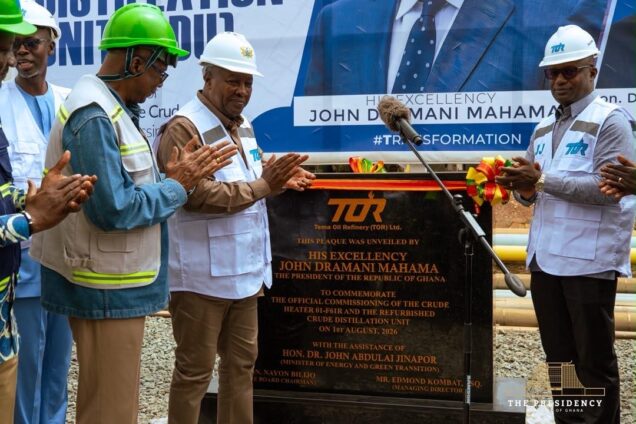
Mahama Commissions Refurbished TOR Crude Distillation Unit, Commends Management for Historic Turnaround
President John Mahama commissions the refurbished Crude Distillation Unit at Tema Oil Refinery as TOR resumes operations, processes one million barrels of Jubilee crude and advances Ghana's 24-Hour Economy agenda.
ACCRA, Ghana – August 2, 2026 – President John Dramani Mahama has officially commissioned the refurbished Crude Distillation Unit (CDU) at the Tema Oil Refinery (TOR), describing the milestone as a significant achievement in Ghana's industrial recovery and energy security agenda.
The commissioning marks the return of Ghana's only state-owned refinery to full production after years of operational challenges and signals renewed confidence in the country's strategy to increase local petroleum refining capacity. During the ceremony, President Mahama praised the management, board, employees and strategic partners of TOR for successfully restoring operations without direct financial support from the Government of Ghana.
A Strategic Asset Returns
The Crude Distillation Unit (CDU) is the heart of every oil refinery. It is the first processing unit that receives crude oil and separates it into various petroleum fractions such as:
Liquefied Petroleum Gas (LPG)
Naphtha
Gasoline
Kerosene
Diesel
Heavy fuel oil
These products undergo further processing before being supplied to industries, transport operators and consumers.
The successful refurbishment means TOR can once again refine crude oil locally rather than relying heavily on imported refined petroleum products, an important development for Ghana's energy independence.
One Million Barrels Already Processed
The commissioning ceremony also celebrated another milestone—the successful processing of one million barrels of Ghana's Jubilee Field Medium Sweet Crude Oil into finished petroleum products.
According to President Mahama, since May 2026 TOR has successfully received and processed three separate cargoes of approximately one million barrels each, including:
Bonga Crude
Baleine Crude
Jubilee Medium Sweet Crude from Ghana
The President emphasized that TOR fully paid for the locally produced Jubilee crude, demonstrating the refinery's improving financial position and commercial viability.
More Than Just the CDU
Beyond refurbishing the Crude Distillation Unit, the refinery has completed several critical engineering projects, including:
Restoration of the Residual Fluid Catalytic Cracking Unit (RFCC)
Installation of a new F-61 crude heater
Return of Boiler Number Eight into service
Together, these upgrades significantly improve refinery reliability, efficiency and production capability.
Mahama: Proof That State Enterprises Can Succeed
President Mahama described the turnaround as evidence that well-managed state-owned enterprises can become profitable and efficient.
"TOR has achieved all this on its own. The Government of Ghana has not put a single cedi into this rebound."
He commended Energy and Green Transition Minister Dr. John Jinapor, TOR Board Chairman Nayon Bilijo, Managing Director Edmond Kombat, management and staff for reversing years of decline through innovation, discipline and strategic leadership.
TOR by the Numbers
The refinery remains one of Ghana's most important industrial assets.
Indicator
Details
Commissioned
1963 (originally GHAIP)
Current Owner
Government of Ghana
Core Facility
Crude Distillation Unit (CDU)
Recent Local Crude Processed
1 million barrels (Jubilee crude)
National Role
Ghana's only state-owned petroleum refinery
Strategic Goal
Reduce imports of refined petroleum products
President Mahama also directed TOR management to prepare a roadmap to expand refining capacity to 100,000 barrels per day, positioning the refinery to meet growing domestic demand while supporting exports within the ECOWAS region.
Economic Significance for Ghana's 24-Hour Economy
The revival of TOR aligns closely with Ghana's industrial transformation agenda and the government's 24-Hour Economy policy.
A fully operational refinery contributes to:
Lower dependence on imported fuel
Improved foreign exchange conservation
Increased value addition to Ghana's natural resources
Stable fuel supply for industries operating around the clock
Job creation across manufacturing, logistics and petroleum services
Enhanced competitiveness for local manufacturing
Reliable domestic refining also strengthens supply chains for transport, mining, agriculture, aviation and manufacturing—key sectors expected to drive continuous economic activity under the 24-Hour Economy initiative.
Why This Matters
Energy remains one of the largest cost components for businesses. A stronger domestic refining industry can improve fuel availability, reduce supply disruptions and help stabilize input costs for businesses.
For investors, the reopening of TOR presents opportunities in:
Petroleum logistics
Petrochemicals
Storage infrastructure
Marine transport
Engineering services
Maintenance and industrial contracting
Oil marketing and distribution
Energy technology
Looking Ahead
While the refurbishment marks a significant milestone, sustaining TOR's success will depend on consistent crude supply, sound corporate governance, regular maintenance, financial discipline and continued investment in modern refining technology.
If the refinery continues on its current trajectory, it could become a cornerstone of Ghana's industrial revival and an important contributor to the country's ambition of building a resilient, value-added economy powered by continuous industrial production.
Suggested Tags: Ghana, John Mahama, , TOR, , , , Energy Security, Petroleum, Refinery, Industrialisation, 24-Hour Economy, Manufacturing, ,
Disclaimer:
The views expressed on this site are those of the contributors or columnists, and do not necessarily reflect 24HourBusiness.com's position. 24HourBusiness.com will not be responsible or liable for any inaccurate or incorrect statements in the contributions or columns here.
Ghana Armed Forces engineers have completed the 175.6km Accra–Kumasi Expressway right-of-way clearing in 19 weeks, marking a major infrastructure milestone for Ghana.
GCB Bank has overtaken Ecobank Ghana in deposit market share, emerging as Ghana’s largest deposit-taking bank as industry deposits rise to GH¢334.3 billion
Aug 18, 2026
260
Premium Industrial Header Ad Zone Space (Available for Placement)
 Export, Trade & Logistics