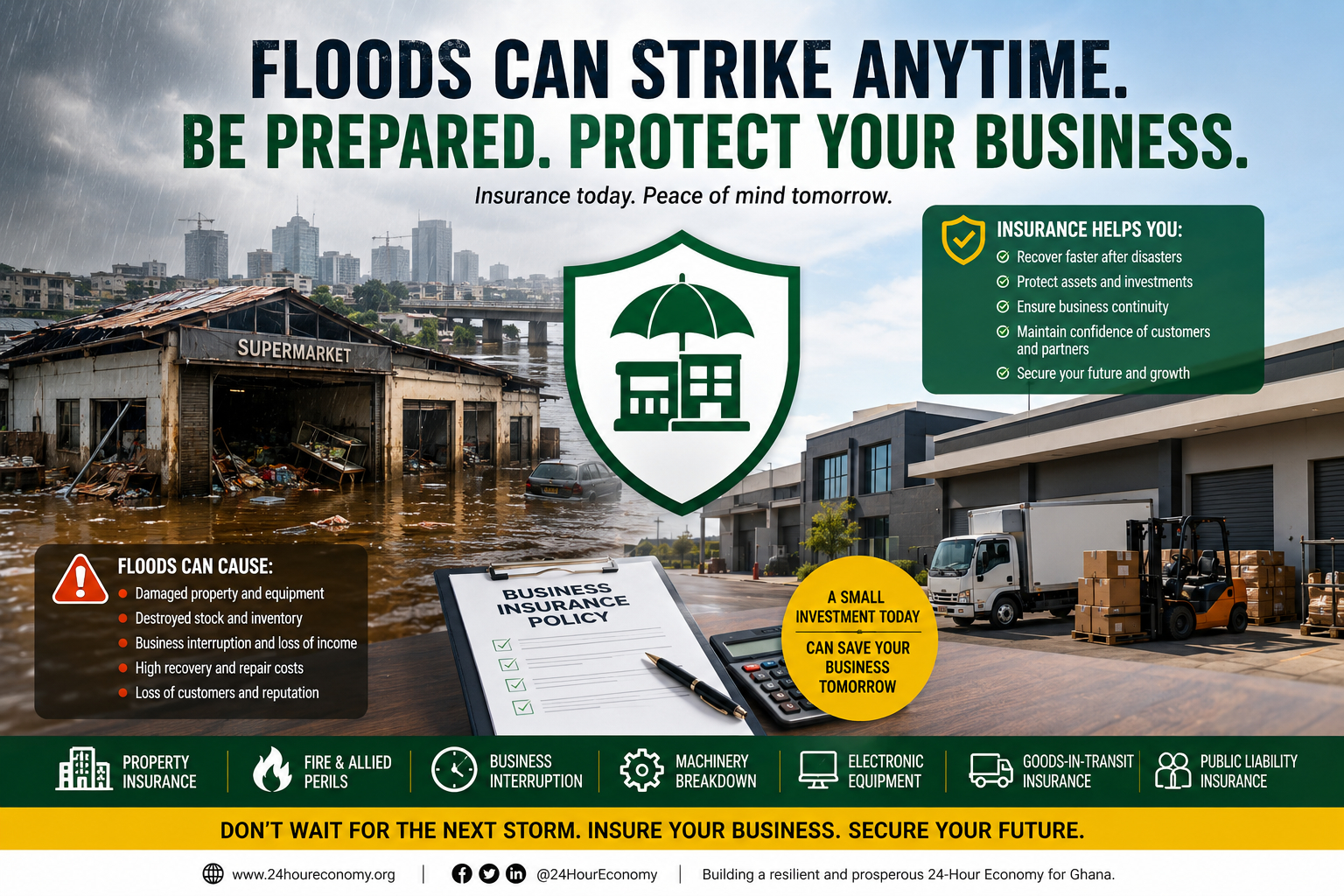
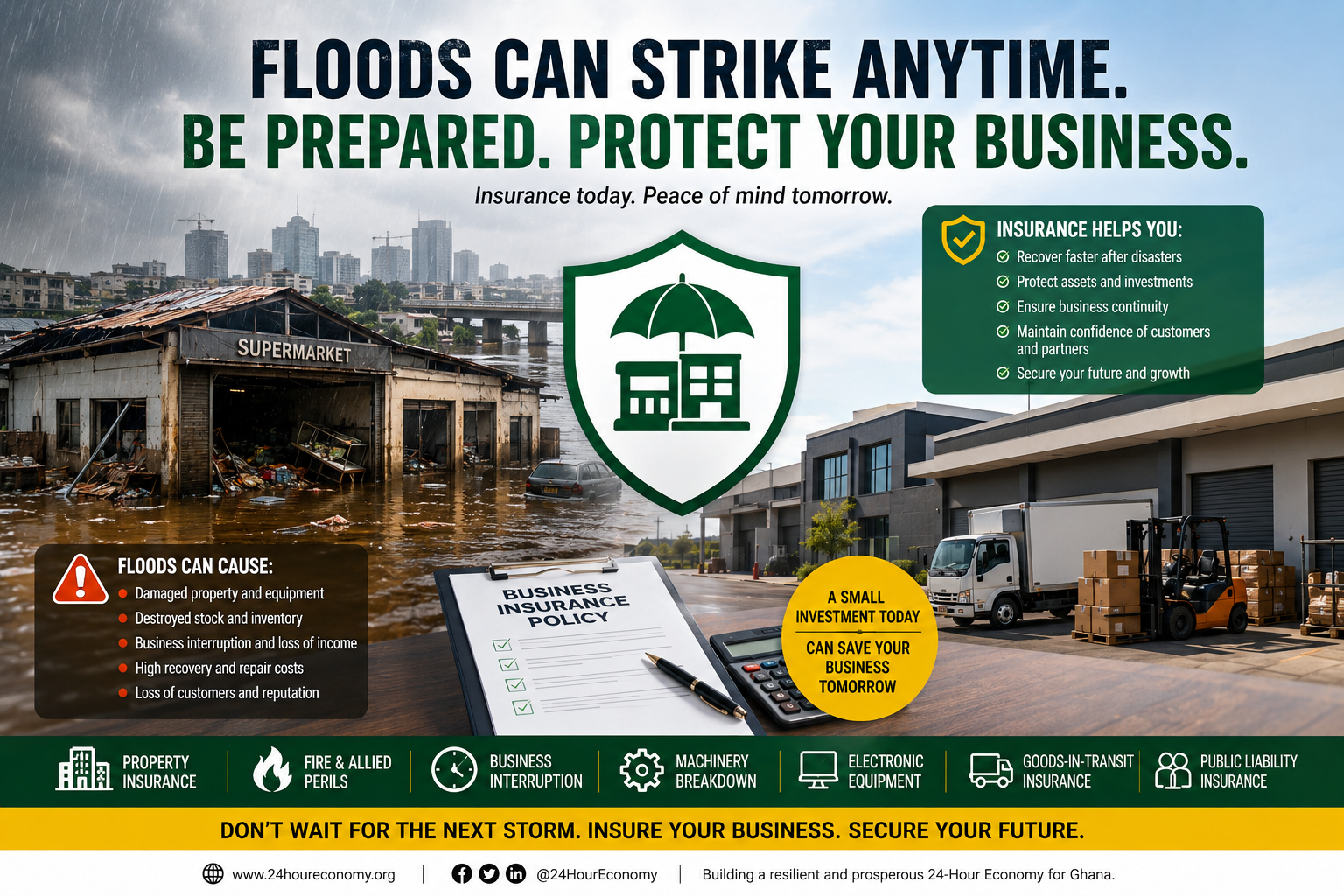
The June 2026 floods across Greater Accra once again exposed the financial vulnerability of thousands of businesses. The insurance industry reports that flood-related claims continue to rise, with estimates approaching GH¢500 million, highlighting the enormous economic cost of natural disasters.
By 24HourEconomy.org Business Desk
ACCRA, Ghana – The recent floods that swept through parts of Accra left more than submerged roads and damaged buildings. They disrupted supply chains, halted business operations, destroyed inventories, damaged equipment, displaced workers and reminded business owners that one day of extreme weather can erase years of investment.
As Ghana works towards building a vibrant 24-hour economy, business resilience has become just as important as business growth. While investments in drainage infrastructure, urban planning and climate adaptation remain essential, one risk management tool continues to be underutilised by many enterprises and that is insurance.
The Cost of Doing Nothing
When floodwaters enter a shop, warehouse or factory, the losses extend far beyond damaged property.
Businesses may experience:
- Destruction of stock and raw materials.
- Damage to machinery, computers and production equipment.
- Closure of business premises for several days or weeks.
Loss of sales and customer confidence.
Additional costs of cleaning, repairs and temporary relocation.
For many small and medium-sized enterprises (SMEs), such losses can threaten their survival, especially when they rely solely on personal savings to recover.
The June 2026 floods across Greater Accra once again exposed the financial vulnerability of thousands of businesses. The insurance industry reports that flood-related claims continue to rise, with estimates approaching GH¢500 million, highlighting the enormous economic cost of natural disasters.
Insurance Is More Than Compensation
Many entrepreneurs view insurance as an unavoidable business expense. In reality, it is an investment in business continuity.
Insurance allows businesses to recover more quickly after unexpected events by helping to finance repairs, replace damaged assets and restore operations with minimal disruption.
For businesses operating under Ghana's emerging 24-Hour Economy framework, continuity of operations is especially critical. A manufacturing company running three shifts cannot afford prolonged shutdowns caused by uninsured losses.
Similarly, retailers, logistics companies, hospitals, hotels, restaurants and warehouses depend on uninterrupted operations to serve customers around the clock.
What Insurance Can Protect
Depending on the nature of the business, insurance protection may include:
- Commercial property insurance for buildings and business premises.
- Fire and allied perils insurance, which may include flood cover where applicable.
- Business interruption insurance to compensate for lost income during temporary closure.
- Machinery breakdown insurance.
- Electronic equipment insurance for servers, computers and communication systems.
- Goods-in-transit insurance.
- Public liability insurance for businesses that receive customers.
Business owners should carefully review their policies with licensed insurers or brokers to understand exactly which risks are covered, including flood-related damage, exclusions and claim procedures.
Climate Change Is Changing Business Risk
Scientists and disaster management experts have consistently warned that extreme weather events are becoming more frequent due to climate change.
The recent rainfall in Accra was among the heaviest recorded in years, resulting in widespread flooding, rescue operations and significant disruption to economic activity.
These events reinforce an important reality: flood risk is no longer confined to businesses located near rivers or coastal areas. Urban flooding caused by inadequate drainage, blocked waterways and intense rainfall can affect commercial districts, industrial areas and residential communities alike.
The Business Case for Insurance
Beyond financial protection, insured businesses often enjoy several advantages:
- Faster recovery after disasters.
- Greater confidence from banks and investors.
- Improved credibility with customers and business partners.
- Better long-term financial planning.
- Reduced dependence on emergency loans after disasters.
-
For lenders, insurance also protects financed assets, making it easier for businesses to access credit for expansion.
Insurance Supports a Stronger 24-Hour Economy
A successful 24-hour economy depends on businesses that are productive, resilient and capable of operating despite unexpected disruptions.
Insurance should therefore be viewed as part of Ghana's economic resilience strategy. Just as businesses invest in security systems, backup generators and cybersecurity, they should also invest in financial protection against risks that cannot be prevented.
The recent floods serve as a reminder that while businesses cannot control the weather, they can control how prepared they are when disaster strikes.
Editorial Perspective
As Ghana accelerates the implementation of its 24-Hour Economy agenda, business resilience must become a national priority. Public investment in flood mitigation, better drainage systems and urban planning should be complemented by stronger insurance awareness and wider adoption of risk management practices among businesses.
For entrepreneurs, the question is no longer whether flooding will occur again. The more important question is whether their businesses will be financially prepared when it does.
Building a competitive economy requires more than longer operating hours. It requires businesses that can withstand shocks, recover quickly and continue creating jobs despite increasingly unpredictable weather.
 Business & Finance