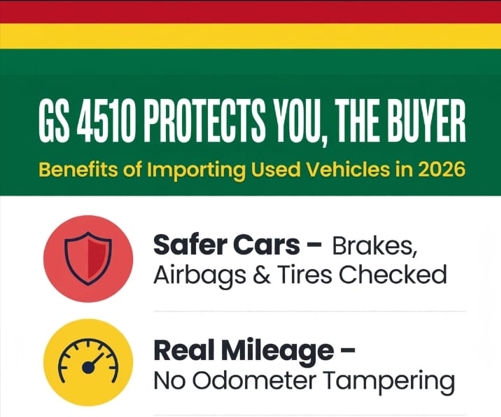
The new enforcement regime is expected to reduce the entry of accident-damaged, flooded, burnt, excessively worn and otherwise unsafe vehicles into Ghana while creating a more transparent and level playing field for responsible importers and dealers.
New enforcement regime takes effect October 1, 2026, strengthening pre-shipment checks and vehicle traceability
Ghanaian car buyers and legitimate vehicle importers are set to benefit from stronger controls on vehicles entering the country as the Ghana Standards Authority (GSA) begins enforcement of its National Vehicle Homologation and Conformity Assessment Programme from October 1, 2026.
The new enforcement regime is expected to reduce the entry of accident-damaged, flooded, burnt, excessively worn and otherwise unsafe vehicles into Ghana while creating a more transparent and level playing field for responsible importers and dealers.
Stronger checks before vehicles reach Ghana
Ghana relies heavily on imported vehicles, particularly used vehicles. Under the new regime, conformity assessment will become an increasingly important part of the import process.
For used vehicles, the objective is to establish that vehicles meet applicable Ghanaian standards before they are shipped. This means that importers will have greater certainty about whether a vehicle is acceptable for the Ghanaian market before committing significant funds to its purchase and shipment.
The programme is also expected to strengthen vehicle identification and traceability, helping authorities establish the identity and history of vehicles entering Ghana.
What does this mean for car buyers?
For consumers, the reforms could provide an important layer of protection.
One of the longstanding problems in Ghana's used-vehicle market has been the arrival of vehicles that may look attractive and inexpensive at the point of purchase but later become expensive to repair because of hidden accident damage, flooding, poor repairs or excessive wear.
Stronger conformity assessment can help reduce the likelihood that such vehicles reach consumers.
It also reinforces an important principle: the cheapest vehicle is not necessarily the cheapest vehicle to own.
A vehicle that has passed the required conformity checks should give buyers greater confidence that it meets the applicable requirements for the Ghanaian market.
Relief for legitimate importers
The reforms could also benefit legitimate vehicle importers and dealers.
Responsible businesses that invest in compliant vehicles have often had to compete with operators bringing in lower-quality vehicles at reduced costs. Stronger enforcement can narrow that gap by requiring vehicles entering the market to meet the same basic standards.
The GSA's programme covers both new and used vehicles, while broader certification requirements extend across vehicle manufacturing, assembly, repair, maintenance, servicing and disposal.
More than vehicle imports
The GSA says Ghana's automotive sector must be viewed as a complete industrial ecosystem rather than simply a business of putting vehicles on the country's roads.
The ecosystem includes vehicle manufacturing and assembly, research and innovation, testing and certification, inspection, dealerships, financing, insurance, repairs, spare parts, vehicle registration and data managementas well as electric mobility infrastructure.
It also includes the increasingly important issue of end-of-life vehicles; including their recovery, recycling and responsible scrapping.
The GSA has already homologated more than 150 vehicle models under the programme, covering brands including Toyota, Volkswagen, Nissan, Ford, Honda, Hyundai, Chevrolet, MG, Citroën and Peugeot.
A new era for Ghana's vehicle market
The October 1 enforcement is therefore more than another regulatory requirement for importers. It represents a shift toward a more structured automotive marketplace in which vehicle quality, safety, traceability and conformity become central to the importation and sale of vehicles.
For consumers, that could mean greater protection. For legitimate importers, a fairer competitive environment. And for Ghana's automotive industry, it could support the development of a more organised and sustainable value chain.
The message for importers is clear: vehicle compliance must increasingly be addressed before shipment, not after the vehicle arrives in Ghana.
For buyers, the emerging message is equally important: ask questions about a vehicle's conformity, identification and history before paying for it.
The GSA's reforms are ultimately intended to ensure that vehicles entering Ghana are not merely available for sale, but are suitable for the roads, the environment and the people who depend on them.
 Export, Trade & Logistics